Rockville, MD · Garage Door Service
Derwood's 764 households sit close together, and most garages date to the mid-1980s. We drive 2 miles from Rockville to fix snapped or frayed cables on that stock.
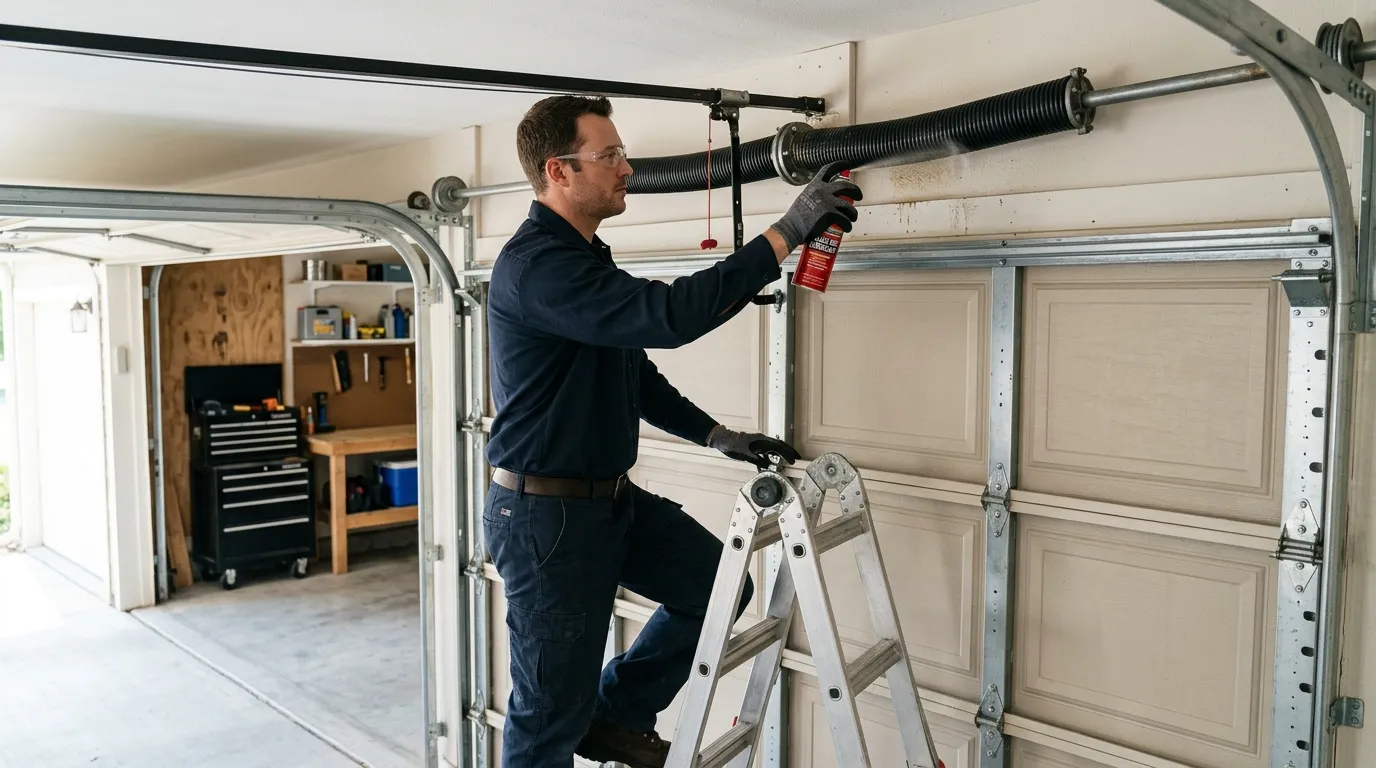
Derwood is a small place - 764 households, tucked in tight compared to the sprawl further out toward Olney or Montgomery Village. That size matters here: a town this compact doesn't generate a high volume of cable calls in any given week, so when one comes in, it's usually a single household dealing with a door that won't open evenly or a cable that's jumped the drum.
We come from Rockville, about 2 miles away, so travel isn't the long part of the job. The cable work itself - pulling tension off the spring safely, removing the old cable, seating a new one on the drum, checking the drum groove for wear - usually runs under an hour on a standard double door once we're on site. If the drum itself is grooved from the old cable riding wrong, that adds time, because we're not just swapping a cable, we're replacing the part that chewed it up.
Most garages in Derwood went up around 1985, which puts them past the era of the oldest one-piece doors but still well before today's higher-cycle galvanized cable became standard. What we find most often is the original extension-spring cable setup, sometimes with a cable that's stretched or frayed at the drum end rather than snapped clean.
The fix starts with releasing spring tension safely - this is not a step to skip or rush, and it's where most DIY attempts go wrong. From there we pull the old cable, inspect the drum and the bottom bracket it anchors to, and run a new cable sized to the door's weight and track length. If the bracket or drum shows wear from years of a cable riding slightly off, we replace that too, because a new cable on a chewed-up drum just fails again in a season or two.
Cable failure has a cause, and in a place like this the cause is usually cold, not age alone. This service area sits in a cold, severe winter climate, and cable failures cluster in the coldest stretches because the steel gets brittle right where it flexes hardest - at the drum and at the bottom bracket. A cable that's been fraying quietly all fall can finally give on the first hard freeze.
Houses built around 1985 also tend to have their original galvanized coating starting to thin at the wear points by now, decades in. That's not a defect, it's just the timeline - a cable coated in the mid-1980s has had close to forty winters to wear thin exactly where it bends. Once the coating goes, the strand underneath rusts and weakens faster than the rest of the cable, and that's the section that lets go.
The most common version of this call: the door goes up crooked, one side higher than the other, or it stops a few inches up and won't move further. That's a cable that's either jumped its drum or partially given way - the door is still attached on one side and dead weight on the other, and the opener can't muscle it through that imbalance.
A fully snapped cable looks different - the door won't budge at all, or it drops fast and uneven when someone tries to force it by hand. Either version means stop using the opener immediately. Running the motor against a bad cable strains the opener gears and can bend the track, turning a cable job into a bigger repair.
One honest limit here: if the drum or bottom bracket is bent from the door coming down unevenly, cable replacement alone won't fix it. That's a separate part, and we'll tell you straight if that's what's going on rather than sending you off with a cable that'll fail again against a bent bracket.
It usually wasn't sudden - the strand was fraying at the drum or bottom bracket for a while, often worse in cold weather when the steel gets brittle. What looks sudden is usually the last thread of a slow failure, and cold snaps are when we see the most of these calls.
Not on your own. A door with one cable gone is unevenly supported, and the spring is still under tension. Leave it closed if possible and don't run the opener against it - that strains the opener and can bend the track.
We size cable to the door on site rather than guessing ahead of time, since weight and track length vary even among houses built the same year. If a drum or bracket needs replacing too, that's a separate part we carry standard stock for, not a special order.
Call now or request a free quote - same-day service on most repairs, upfront written pricing.