Rockville, MD · Garage Door Service
Garage door off track in Rockville? We explain why 1960s-70s tracks and cold winters push doors off their rollers, and how we fix it right the first time.
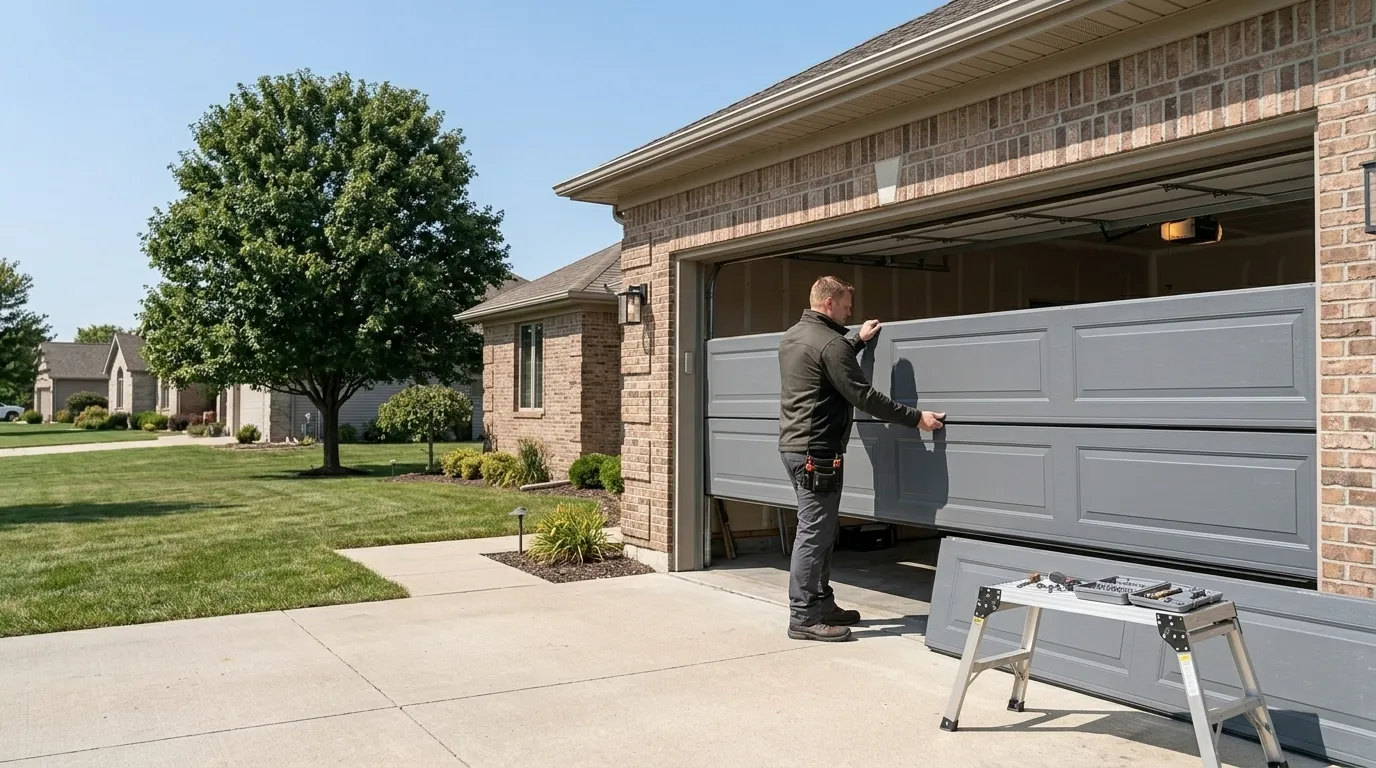
When a door jumps its track, the fix depends on why it jumped. We start by checking the rollers before we touch anything else, because a bent track is almost always a symptom, not the cause. If a roller has seized or cracked, that's usually what forced the door sideways until it climbed off the rail.
Next we check the cables and the bottom brackets. On the older torsion setups still common through this service area's 1960s and '70s housing stock, a frayed cable or a loose bracket bolt will let one side of the door drop faster than the other, and that twist is what bends the track.
Once we know the cause, the repair itself is usually straightforward: we re-set the door on the rollers, straighten or replace the bent section of track, and true up the alignment so both sides travel evenly. If the track is bent badly enough - a hard kink, not just a bow - we replace that section rather than hammer it back into shape. A hammered-straight track will hold for a while and then fail again at the same spot, which costs the homeowner two service calls instead of one.
We don't recommend replacing a whole door over a track problem unless the panels themselves are damaged. Most off-track calls are a one-hour fix, not a door replacement.
Housing in this area was built mostly between 1948 and 2014, with the median home going up around 1970, and most of what we work on falls into that 1960s-70s wave across the 62 named communities we cover. Doors and openers from that era, or replacements installed to match the original rough opening, tend to run on lighter-gauge track and steel rollers rather than the nylon rollers and heavier track sold today.
That matters because this region sits in a cold, severe climate band. Steel rollers contract in freezing temperatures more than nylon does, which tightens the clearance between roller and track. A door that ran smoothly in October can bind in January on the exact same hardware, and a binding door under spring tension is a door that jumps track.
We also see this on garages that never got insulated when the house was built - a common situation in that 1948-2014 stock - where the temperature swing between the garage interior and outside air is wider than in a conditioned space. Wider swings mean more contraction and expansion cycles on the hardware every winter, and each cycle is another chance for a roller to bind and a track to flex.
An off-track door is rarely just a track problem, and treating it like one is how a $150 fix turns into a $400 one. If the door came off track because a cable snapped, the door is now unsupported on one side and can drop without warning - that's not a job to diagnose from a ladder, and it's not one to leave overnight.
On older torsion systems typical of the 1960s-70s builds across this service area, the spring itself may be original to the house. A spring that's fifty-plus years old and now under uneven load from a twisted track is more likely to fail during the repair than a newer one. We check spring condition before we put any weight back on the system.
We also see openers that kept trying to run the door after it left the track. The motor doesn't know the door is off-rail; it just keeps pulling until something gives, which can strip the drive gear or burn out the motor. If your opener made grinding noises before the door came off track, or kept running after it stopped moving, that's a separate check we do while we're already there.
One honest limit: if the track is bent in more than one place or the header bracket has pulled away from the framing, that's a structural repair, not a track adjustment, and we'll tell you that upfront rather than force a patch that won't hold.
You'll usually notice it before the door fully leaves the rail. The door hesitates partway up or down, one side rides visibly lower than the other, or you hear a scrape and a pop instead of a smooth roll. Sometimes it's quieter than that - the door just stops responding to the opener and sits crooked in the frame.
If you can see daylight between the roller and the track on one side, or the bottom corner of the door has pulled inward off the vertical rail, stop using the opener. Running the motor against a door that's already off-rail is what turns a track repair into a drive-gear replacement.
A door that's merely rubbing or squeaking on the track is a different, smaller problem - usually just a roller due for grease or replacement. The off-track calls we get are almost always the ones where the door has visibly shifted, not the ones that are just noisy.
Most homes here were built between 1948 and 2014, with steel roller hardware common on the older stock. This region's cold, severe winters make steel contract more than the nylon rollers used today, tightening clearances until a roller binds and forces the door off the rail. It's a seasonal pattern we see across the service area every winter.
We don't recommend it. If a cable has snapped or a spring is under uneven load, the door can drop suddenly while you're working on it. It's a job for someone who can check spring and cable condition first, then reset the door safely.
No. Most off-track calls are a roller, cable, or bent-track repair, not a full door replacement. We only recommend replacement when the panels are damaged or the track is bent in more than one spot along with framing damage.
If the door is only rubbing, it can wait for a scheduled visit. If it's visibly off the rail, unsupported on one side, or the opener keeps running against a stopped door, that needs attention before you use the door again - continued use risks the drive gear or motor.
By Neighborhood
We also handle off track repair in these Rockville-area suburbs.
Call now or request a free quote - same-day service on most repairs, upfront written pricing.