Rockville, MD · Garage Door Service
Rockville Garage Door Pros handles tune-ups and preventive maintenance for the 1948-2014 housing stock across Rockville and nearby Montgomery County towns.
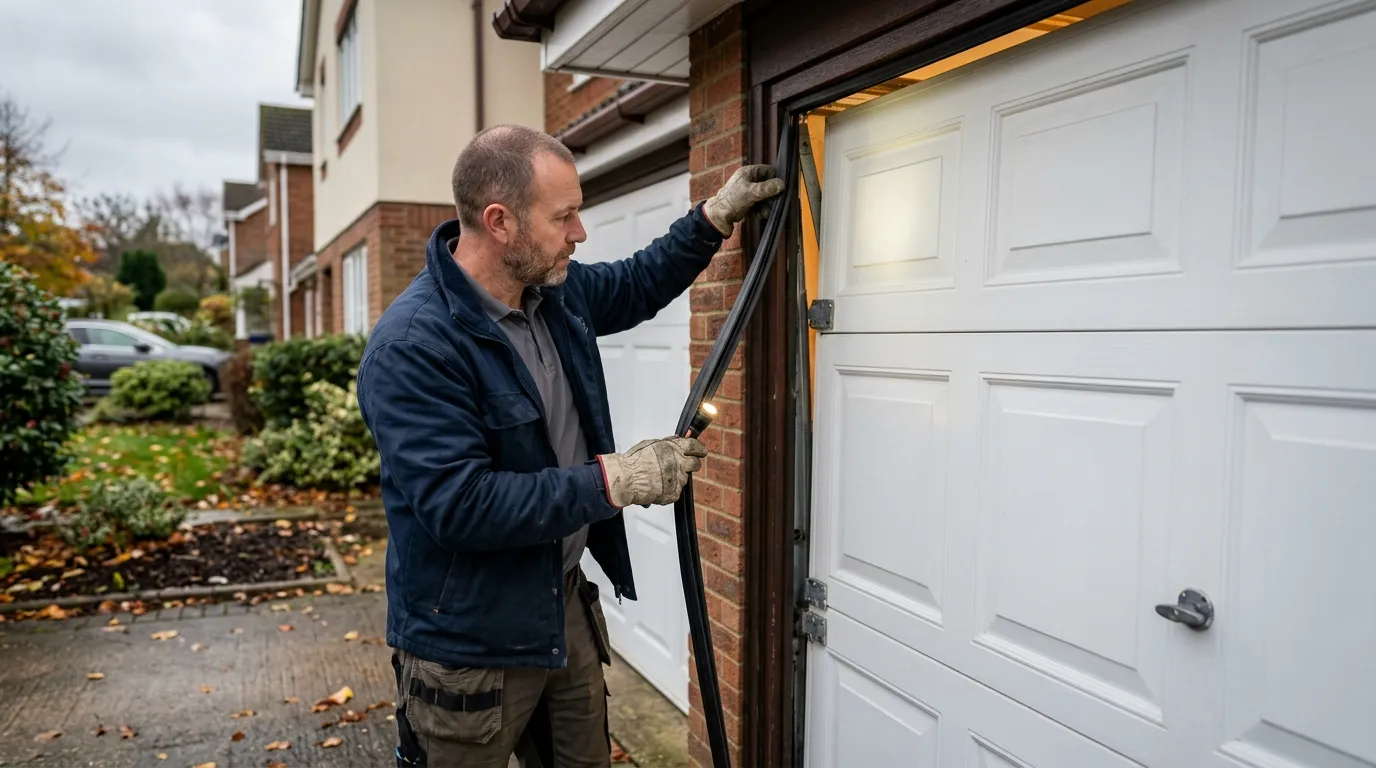
A maintenance visit isn't a quick spray and a wave goodbye. We pull the door off auto-reverse and run it by hand to feel where it binds, check spring tension against the door weight, and look at cable fray where it wraps the drum. Rollers get checked for flat spots and pulled if the bearing's seized. Track alignment gets checked with a level, not by eye, because a track that's off by a quarter inch at the top reads fine at the bottom and still puts side-load on the opener.
We lubricate hinges, rollers, and the torsion spring itself with the right grease, not WD-40, which strips lubricant instead of adding it. Opener force settings get tested against the auto-reverse safety check, since a door that closes on a two-by-four without stopping is a liability regardless of how new the opener looks.
One limitation worth saying plainly: if a spring is already showing rust pitting or a cable strand is visibly frayed, maintenance doesn't buy you more time. That's a repair call, not a tune-up, and we'll tell you that on site instead of charging for a service visit that won't hold.
Most of the housing across this service area went up between 1948 and 2014, with a median build year around 1970, and the bulk of that stock is 1960s and 70s construction spread across 62 named neighborhoods. Doors and openers from that era, or the replacements installed on the original framing, were sized for a different set of expectations than what's sold today. Torsion springs on those older jambs were often matched to lighter doors, and when a homeowner swaps in a heavier insulated door decades later without re-rating the spring, the hardware works harder every single cycle.
The climate band here is classified cold and severe, which matters more than people think for a mechanical system that lives in an unheated garage. Steel expands and contracts, grease thickens in the cold and won't flow into the bearing the way it does at 70 degrees, and a spring under constant tension cycles through more stress reversals per winter than the same spring would in a mild climate. None of that shows up as a dramatic failure. It shows up as a door that's slightly slower to open in January, then a cable that snaps in March.
Age and cold don't fail in isolation, they compound. A house built in the 1960s with original torsion hardware that's never been serviced is already running a spring rated for a lighter door than what's likely hanging on it now. Add a winter where the grease has gone stiff and the steel has contracted slightly, and the extra load lands on a spring that was already undersized. That's how a routine maintenance call turns into an on-the-spot spring replacement instead of a lube and adjust.
Openers complicate this further. A lot of the opener stock in homes built before the 1990s has been replaced once already, sometimes by a previous owner, sometimes without matching the new unit's force settings to the door's actual weight. We see openers straining against a door that was never rebalanced after a panel swap, which burns out the drive gear faster than the opener's rated lifespan would suggest.
We can catch most of this on a maintenance visit if the spring and cables are sound enough to inspect safely. What we can't do is guarantee a 50-year-old spring will hold once it's under a torque wrench, so sometimes the safest move during a tune-up is to recommend replacement rather than push it.
The most common thing we hear on the phone is a door that's gotten noticeably slower, or one that hesitates for a second before it starts moving. Both point at the same root cause across this area's older stock: hardware from the 1960s-70s build era running through another cold-climate winter without a service interval to catch stiffening grease or an early rust spot on the spring coil.
A close second is a door that closes unevenly, dropping faster on one side than the other. That's usually a cable stretching or a roller binding in a track that's shifted slightly with the house's foundation settling, common in stock built decades ago on older slab or crawlspace foundations. Left alone through another cold season, an uneven door puts twisting load on the opener's drive and on whichever spring is doing more of the work.
Neither symptom is an emergency by itself. Both are the kind of thing a maintenance visit catches months before the cable actually lets go.
Once a year is the baseline we recommend given the cold and severe climate band this area sits in. Grease and metal both behave differently after a winter of temperature swings, so an annual check catches stiffening, rust, and cable wear before they turn into a break.
Sometimes, but not always. If the spring shows rust pitting or the coils look uneven, a tune-up won't extend its life meaningfully. We'll inspect it on site and tell you honestly whether it's a lubrication issue or a replacement job before we do any work.
Yes. A lot of the opener stock in homes from the 1960s-70s era has been swapped at least once, sometimes without rebalancing force settings to the door's current weight. We check that setting against the actual door during every maintenance visit, not just the drive chain.
By Neighborhood
We also handle maintenance in these Rockville-area suburbs.
Call now or request a free quote - same-day service on most repairs, upfront written pricing.