Rockville, MD · Garage Door Service
Derwood homes date mostly to 1985, later than Rockville's older stock, with steel sectional doors and torsion springs now nearing 40 years and due for repair.
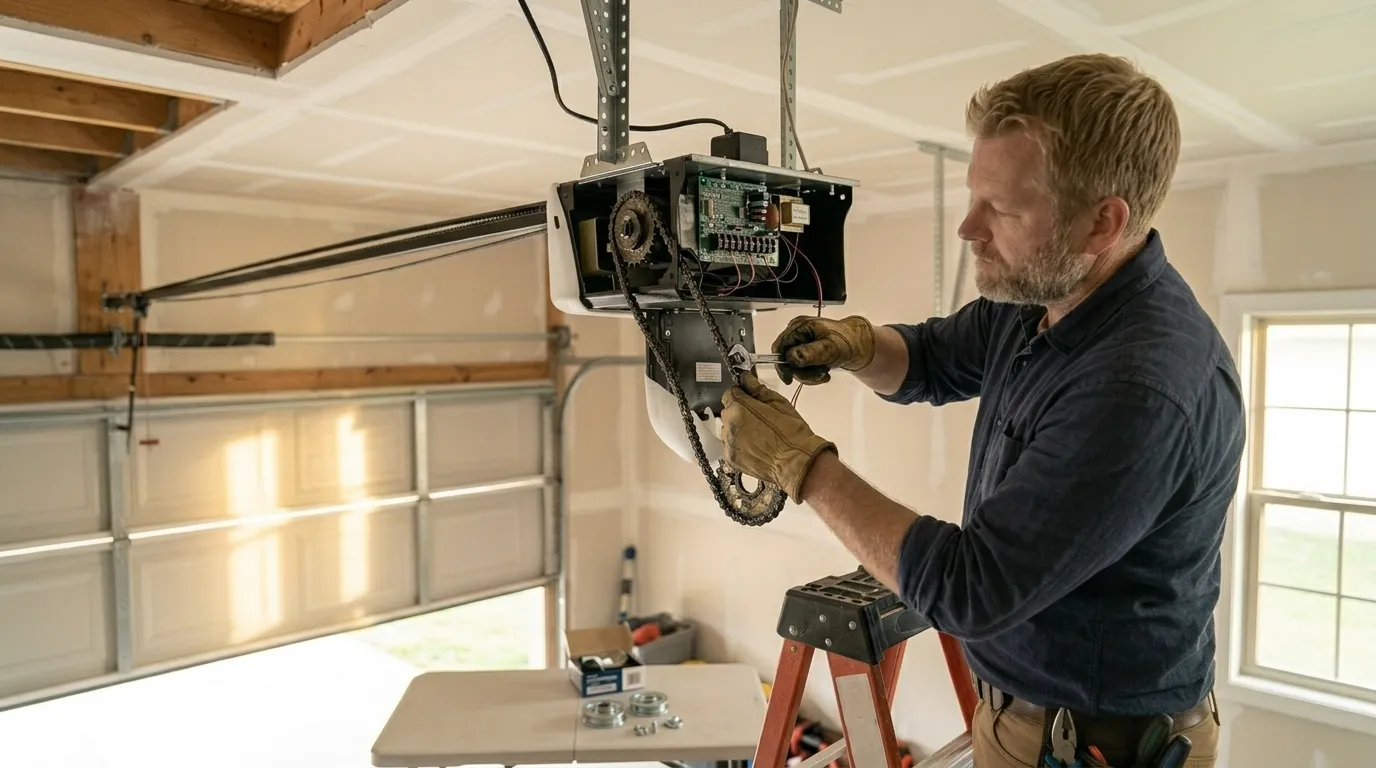
Most garage doors in Derwood are steel sectional units, put up when the neighborhood filled in around 1985 - full sixteen-by-seven doubles on torsion springs, not the older single doors on extension springs you still find in the area's 1960s and 70s pockets. That later build date matters more than most owners realize, because it puts a lot of Derwood's original hardware right at the point where torsion springs and bearing plates start failing.
We run out of our Rockville shop, and Derwood sits about two miles down the road, so getting a truck to you isn't the bottleneck. What can slow a job down is parts. If your opener or spring is an older size that isn't a stock item, we may need a day or two to get it in before we can finish the repair. We'll tell you straight when that's the case rather than promise a same-day fix we can't back up.
For a broken spring or a door off its track, most jobs are a single visit once we're on site and have the right part in the truck. For anything involving a full panel replacement on an older 1985-era door, expect that lead time to matter more than the two-mile drive ever will.
On a steel sectional door from this era, the two most common calls are a snapped torsion spring and a bent track from a car clipping the bottom panel. The spring job is straightforward: we unwind and pull the old torsion spring, match the wire gauge and wind to the door's actual weight rather than a generic size, and reset the cable drums so both sides lift evenly. Skipping that balance step is why some doors come back a year later still sagging on one side.
Track and roller issues are the other steady flow of work. A door built in 1985 usually has steel rollers, not nylon, and after decades of use those wear a groove into the track that throws the whole panel out of alignment. We replace the section of track, swap in nylon rollers, and check the opener's travel limits since a misaligned track often trips the safety sensors long before anyone notices the roller itself.
At a median household income of $93,000 here - lower than the $117,493 average across the wider service area - we see more owners choose a spring or panel repair over a full door replacement, and for a door that's structurally sound, that's usually the right call. We'll always tell you when repair doesn't make sense anymore.
The wider service area sits in a cold-severe climate band, and that hits 1985-era steel doors in a specific way. Cold contracts the torsion spring's coil tighter than its summer tension, which adds stress right at the point the spring already carries the most load. A spring installed when the house was built is now closing in on 40 years old, and cold mornings are exactly when an aging spring is most likely to let go.
Most of these doors are also single-skin steel without much insulation, since that wasn't standard in Derwood's build era the way it is in newer construction. Cold makes the steel panel stiffen and contract slightly, which can bind a track that was set true in warmer weather. The door still opens, but it grinds or catches partway, and owners often mistake that for an opener problem when it's really the panel and track fighting the temperature.
We can't do much about the cold itself - that's a climate fact, not a repair job. What we can do is set the spring tension and track alignment with winter behavior in mind rather than tuning everything on a mild afternoon and hoping it holds.
The call we get most from Derwood is a door that opens fine most of the day but hesitates or grinds on the first cold-morning try. That's the torsion spring and steel track responding to overnight temperature drop the way older, uninsulated doors from this build era do. It's not random, and it's not usually the opener, even though the opener motor is what people hear straining.
A second common symptom is a door that looks level standing still but visibly tilts as it travels - one side reaching the top a beat before the other. On a 1985 door that's almost always an unbalanced spring, not a track problem, because these doors were built with matched cable drums that go out of sync once one spring loses tension.
We don't recommend waiting on either symptom. A spring under uneven load eventually breaks under full tension, and a torsion spring on a full-size double door carries enough stored force to cause a real injury if it lets go while someone's underneath. If your door is doing either of these things, it's worth a call before it does it the hard way.
No. We work out of Rockville, about two miles away, and drive out to Derwood for calls. That distance doesn't change the repair itself, but it does mean parts availability, not travel time, is usually what decides how fast a job gets done.
Most homes here date to around 1985, which puts original torsion springs and steel rollers close to 40 years old. That's past the normal service life for a torsion spring even without the area's cold winters adding extra stress on cold mornings.
For a structurally sound 1985-era steel door, a spring or track repair is usually the more sensible fix. We only recommend full replacement when the panel itself is bent, rusted through, or the door can't hold balance no matter how it's tuned.
Call now or request a free quote - same-day service on most repairs, upfront written pricing.