Rockville, MD · Garage Door Service
Garage door repair for North Kensington's 1958-era homes, six miles from our Rockville shop. Original hardware, worn springs, and what it actually costs to fix.
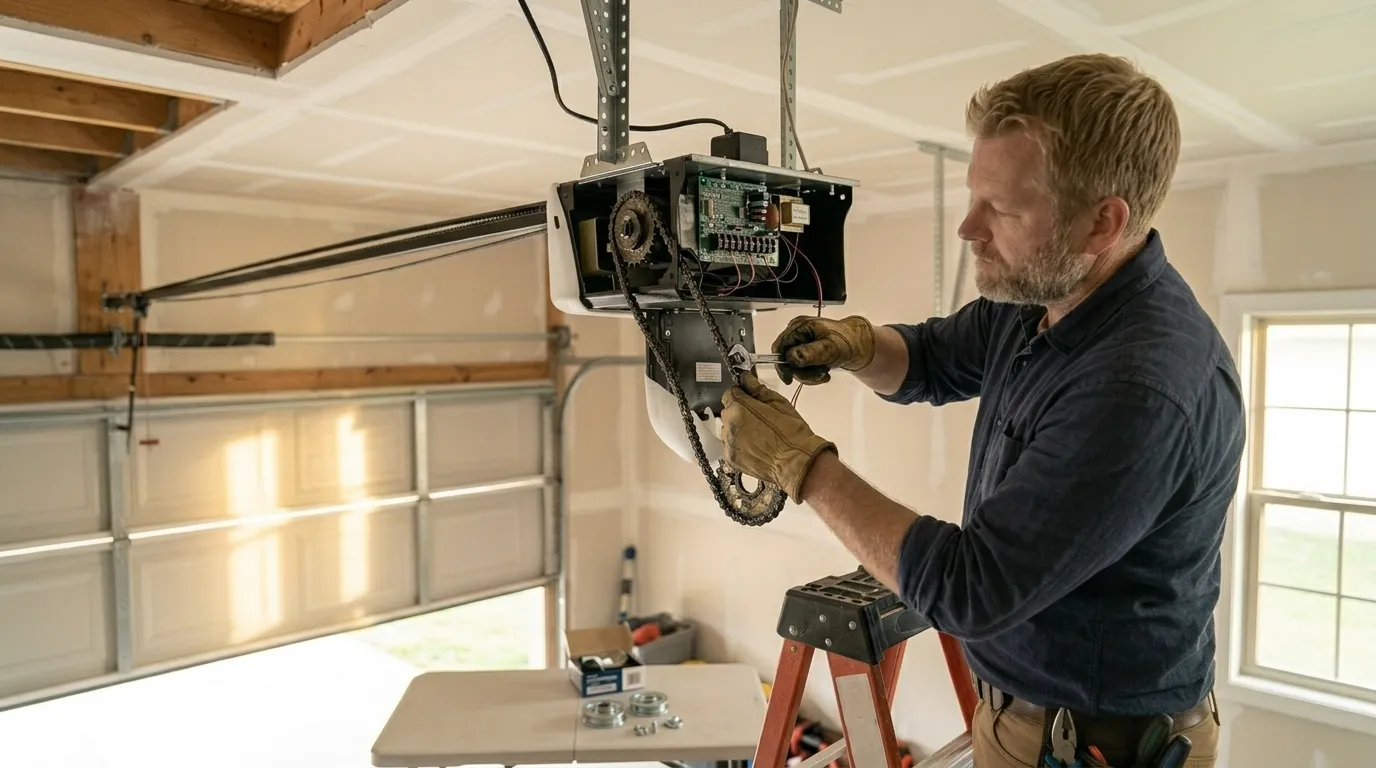
The fault we see most in North Kensington isn't a modern opener glitch - it's hardware that's outlasted its rated life. A house built around 1958 has had its torsion spring cycle tens of thousands of times, and when it finally lets go, the door either won't budge or slams down on its own weight. We pull the old spring, measure the wire gauge and wind against the drum, and set a matched replacement rather than guessing at a universal size, because a lot of these doors were built before standard sizing settled in.
We also check the track and rollers while we're there. On a door this old, the track brackets are often the original ones, bolted into framing that's shifted a little over sixty-plus years. Bending a bracket back into square sometimes solves what looks like a spring problem. If the opener's been swapped out at some point but the door hardware hasn't, we tell you that too - a new opener bolted to tired hardware is why some of these doors feel rough even after a repair.
We don't replace parts that don't need it. If a repair gets the door running safely and quietly, that's the job - not an upsell to a full new door.
North Kensington's housing dates to around 1958, a decade or more ahead of the median build year across the wider Rockville service area, which sits closer to 1970. That gap matters for garage doors specifically: earlier builds often carry side-mounted torsion hardware and steel that predates the heavier insulated panels common in later stock. The springs on these older setups were sized for lighter doors, and if a panel's ever been swapped for something heavier, the original spring is now undersized and wears out faster than it should.
The climate here doesn't help. Winters in this area run cold enough, and consistently enough, that spring steel goes through real thermal cycling every season - contract, expand, repeat, for over sixty years on some of these doors. That's fatigue you can't see from the driveway, and it's why a door that's been fine for years can fail with no warning on a cold morning. This isn't a Rockville-wide issue in the same way - newer stock elsewhere in the service area hasn't had the same number of winters to work through.
We don't have a flat number to quote here without seeing the door - spring size, drum diameter, and how much of the original hardware is still usable all change the job. What we can tell you is what drives the cost up or down on a house like this: if the track brackets are still sound and it's just the spring, that's a straightforward swap. If the bracket's pulled loose from old framing, or the door's a heavier replacement panel on original-weight hardware, that adds labor and sometimes a different spring altogether.
Household income in North Kensington runs a bit higher than the service area average, and we mention that only because it sometimes means owners here are quicker to replace a door outright rather than keep patching sixty-year-old hardware - that's a reasonable call, but it's yours to make, not ours to push. We'll always tell you honestly when a repair is the better bet and when it's throwing money at a door that's due for retirement.
The one we hear most from this pocket of town: the door won't open, or it opens a few inches and stops, and the opener motor sounds like it's straining. That's almost always a broken or badly weakened torsion spring - the opener isn't built to lift the door's full weight on its own, and on a spring that's finally given out after decades, it tries and fails.
A second version: the door drops fast and hard on the way down, sometimes with a bang. Same root cause, different stage of failure - the spring's lost enough tension that it's no longer controlling the descent.
Less common but worth naming: a door that runs but grinds or shudders partway through the cycle. On houses this old that's often a bracket that's worked loose rather than the spring itself, and it's worth having someone look before it turns into a bigger repair.
We work North Kensington out of our Rockville shop, about six miles up the road, so we're not sitting in the neighborhood waiting for calls - we schedule the trip based on what you tell us about the door. A snapped spring or a door that's stuck shut is the kind of call we prioritize; a slow grind or occasional shudder can usually wait a day or two for a slot.
Tell us the age of the house if you know it and roughly what the door's doing - stuck, slamming, grinding, silent opener - and we'll come with the right spring stock rather than showing up and having to order a part. For more on how we handle repairs across the service area generally, see our Rockville garage door repair page; for more on what we see specifically around here, there's also our North Kensington page.
A lot of it comes down to age. Houses here mostly date to around 1958, so the original torsion hardware has been through six-plus decades of cold winters. Spring steel fatigues with repeated temperature swings, and once it's past its cycle life it can go without much warning.
No - we run out of Rockville, about six miles away, and travel in for calls. We don't keep a branch or truck stationed in North Kensington itself, just the one shop covering the wider area.
Often yes, if the track and framing are still sound and it's really just the spring or a bracket. But if the door's a heavier panel bolted onto hardware sized for a lighter original door, replacement sometimes makes more sense long-term. We'll tell you honestly which situation you're in.
We don't quote a fixed response time for North Kensington since we're traveling from Rockville, but a fully stuck or slamming door gets priority scheduling over a minor grind or noise complaint.
Call now or request a free quote - same-day service on most repairs, upfront written pricing.