Rockville, MD · Garage Door Service
Rockville Garage Door Pros serves Montgomery Village, MD, 8 miles out. Homes here date to about 1980, newer than most of the service area, with different door hardware to match.
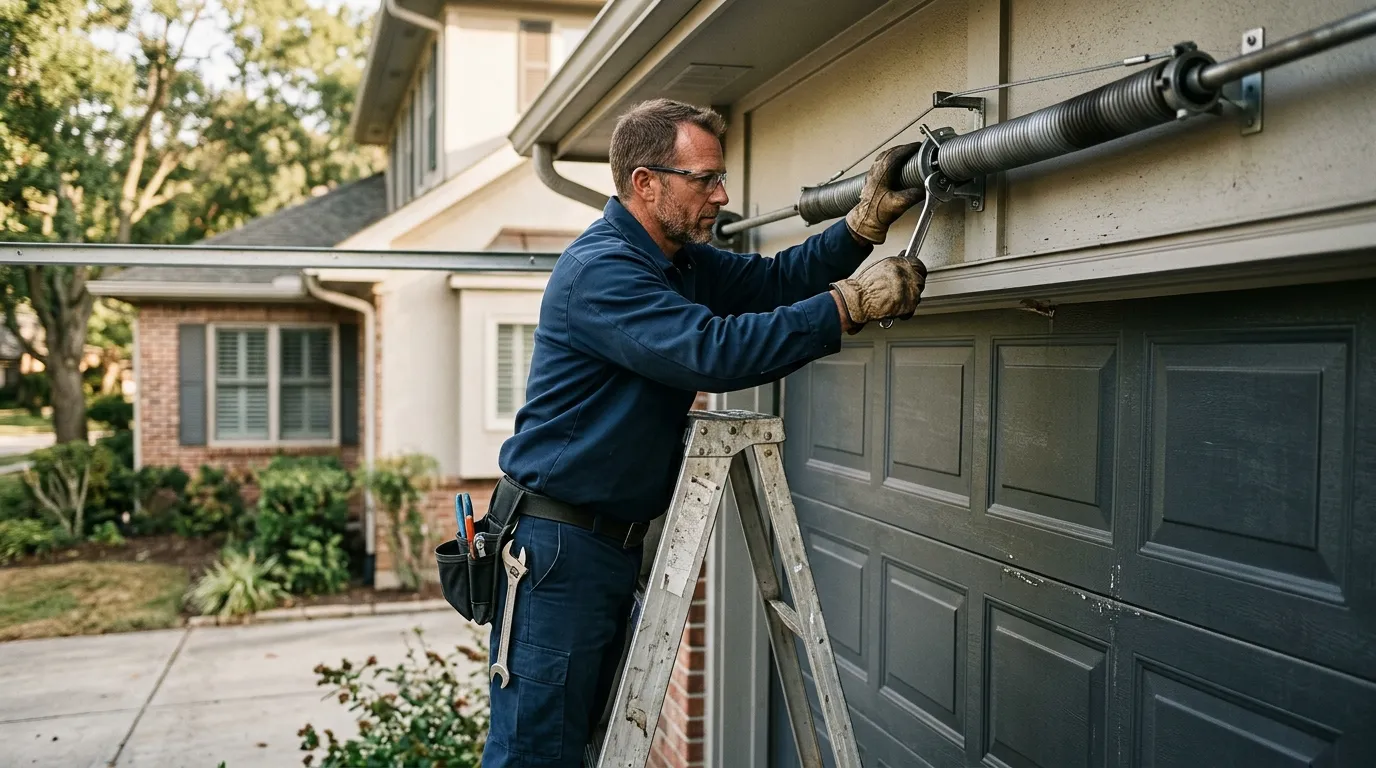
Montgomery Village's housing mostly went up around 1980, a full decade newer than the 1970 median we see across the rest of the service area. That gap matters more than it sounds like it should. Doors installed in 1980 and after were far more likely to ship as steel sectional doors on extension springs, not the older wood one-piece slab doors on side-mounted torsion hardware that still show up on streets built in the 1950s and 60s closer to Rockville. Extension spring systems fail differently than torsion setups - the springs stretch along the horizontal tracks instead of coiling over the header, and the safety cables that keep a broken spring from whipping loose are a part original torsion installs from that era often didn't include at all. If your door dates to the original build, that's likely what's behind your panel. Winters here still hit the same cold-severe conditions as the rest of the region, which stiffens old extension springs and makes brittle plastic idler pulleys the other common failure point on doors from this build era. We don't carry every obsolete extension spring gauge on the truck, so a same-day fix on an older original spring sometimes means a return trip once we've matched the part.
Not every block in Montgomery Village dates to the same stretch. The neighborhood as a whole centers on 1980, but that's a median, and medians hide a spread. Streets built earlier in the development's run lean toward the extension-spring, steel-panel doors described above. Later infill and any newer construction closer to the edges is more likely to have torsion springs mounted on a center shaft over the opening - a setup that's easier to service and, done right, lasts longer under repeated cycling. The practical difference for a homeowner: if your opener struggles to lift the door evenly, or one side sags before the other, that's a symptom that shows up more on older extension-spring doors where one spring has weakened faster than its pair. On newer torsion setups, uneven lift more often points to a bent track or a roller that's jumped its channel. We ask which end of the driveway you're on before we guess at the part, because in this neighborhood that one detail changes the answer more than it would somewhere with a flatter build history.
We run out of Rockville, and Montgomery Village sits about 8 miles from the shop - not a same-block call, but a regular stop on the routes we run through this side of the county. Jobs here usually fall into a run that also covers Aspen Hill and Derwood, both a few miles closer in, and sometimes Colesville or Cloverly depending on where the truck's already headed that day. We don't keep a depot in Montgomery Village itself, so we're straightforward about it: this is a service call from Rockville, not a local walk-in shop. That's worth knowing if you're comparing us to an outfit that's actually based in the neighborhood. What it does mean is a technician who's seen the housing stock on both ends of that 8-mile stretch and knows the difference between what a 1980 build needs and what a 1955 build needs before he's even pulled into the driveway.
Montgomery Village counts about 12,223 households, a small piece of the roughly 322,833 households spread across the wider area we cover out of Rockville. Median household income here runs $96,487, which is meaningfully below the $117,493 median for the service area as a whole. That gap shows up in the kind of calls we get: more requests for a straight repair to keep an original door running, fewer calls where a homeowner wants a full replacement with a premium insulated panel before the old one's actually failed. Neither approach is wrong - a well-maintained extension-spring door from 1980 can still have real life left in it, and we'll say so rather than push a replacement that isn't needed yet. Where replacement does make sense is when the track is bent beyond a clean straightening or the door's wood-composite panels (less common here than on the older stock nearer Rockville, but present on some early-development homes) have started delaminating. At that point, patching costs more over time than doing the job once.
Generally yes. Montgomery Village's housing centers on 1980, about a decade newer than the median across the rest of the service area, so you're more likely to find steel sectional doors on extension springs here rather than the older wood one-piece doors on torsion hardware common on streets built in the 1950s and 60s.
No. We're based in Rockville, about 8 miles away, and Montgomery Village is a regular stop on the routes we run through this part of the county, often alongside Aspen Hill or Derwood on the same day.
Not for this neighborhood. Extension springs, mounted along the horizontal tracks, were standard on many doors installed here around 1980. They fail differently than torsion springs and older installs sometimes lack the safety cables now considered standard, which is worth checking if yours hasn't been inspected.
It depends on the damage. A well-maintained door from that era can still have real life left, and we'll say so rather than push a replacement. Bent tracks beyond straightening or delaminating composite panels are the point where replacing costs less over time than repeated patching.
Call now or request a free quote - same-day service on most repairs, upfront written pricing.