Rockville, MD · Garage Door Service
Rockville homes built mostly in the 1960s-70s meet hard winters that snap torsion springs and freeze openers. We fix the failure, not just the symptom.
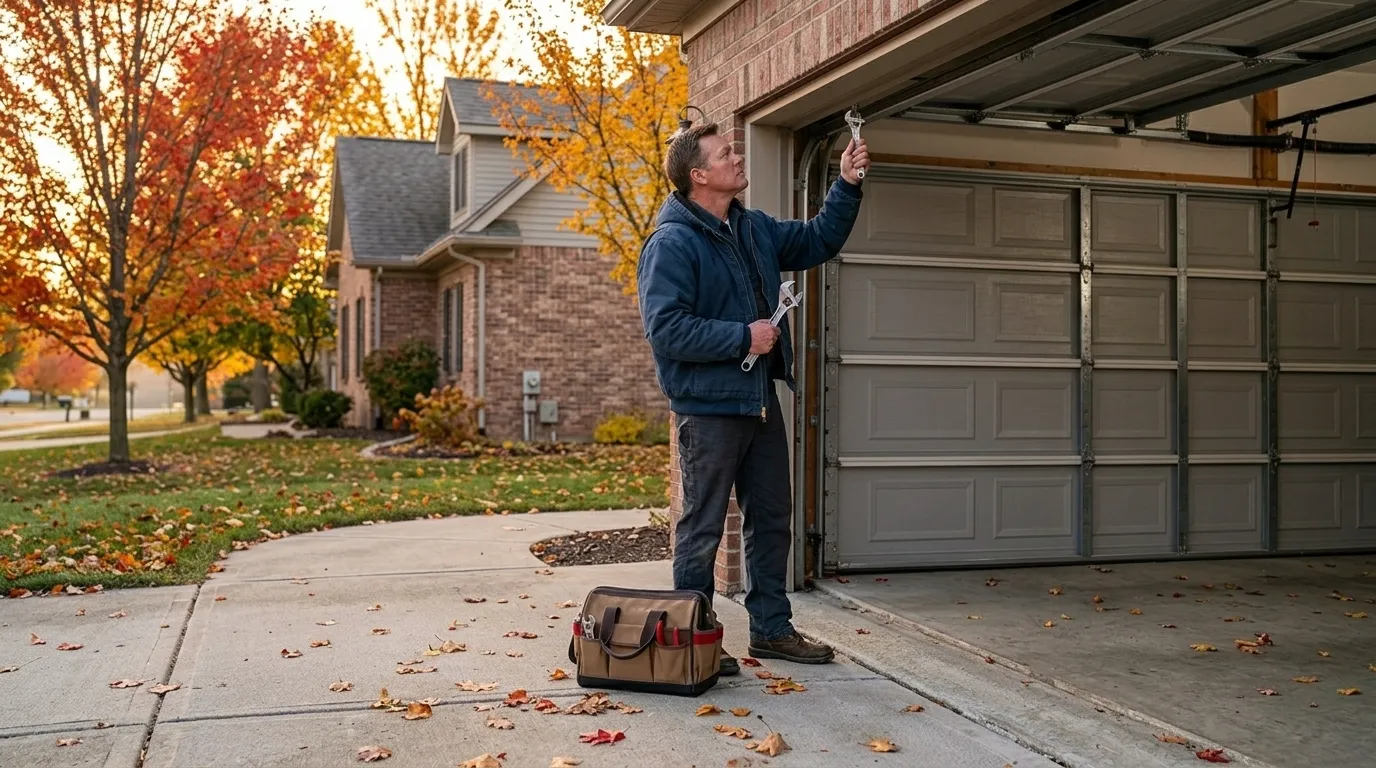
Most calls we get in Rockville start the same way: the door won't move, or it moves and slams. We start at the spring, not the opener, because on a house built in the 1960s or 70s the torsion spring is original-era hardware or a direct swap for it, and it's usually the actual problem even when the symptom shows up at the motor. We check spring wind and cable condition on the drum before we touch the opener's circuit board. If the spring is fatigued from age and cold cycling, we replace it with a spring rated for the door weight, not a generic size off the shelf. If the track is out of plumb, which happens on the older slab foundations common through this area, we reset it rather than forcing rollers through a bent path. On a house with a 1970s-era door and hardware, a straight swap often costs more in parts and labor than the door is worth, and we'll tell you that before we start, not after. We don't replace an opener when the fix is a $20 sensor or a worn belt. That's a judgment call, and it's the one that keeps people calling us back.
Rockville's housing runs from 1948 up through 2014, but the bulk of it, per the 62 named areas around here, was built through the 1960s and 70s. That means a lot of original torsion spring setups are now 50-plus years old, and metal fatigue on a spring is a cycle count problem as much as an age problem. Add a cold-severe climate band and you get contraction and expansion on steel components every winter, which accelerates the fatigue that a milder climate would let coast for another decade. A spring wound for a mild-climate door doesn't behave the same after 50 winters of freeze-thaw stress on the coil. This isn't a design flaw in the door - it's what happens when 1970s hardware meets 2020s winters without anyone touching it in between. Houses in Derwood and Redland, both a few miles out, show the same pattern because they went up in the same building wave.
The complication in Rockville specifically is parts. A door installed in 1968 doesn't take the same spring, drum, or track hardware that ships today, and finding an exact match sometimes means special-ordering rather than pulling from stock. We carry the common sizes for the housing stock built here, but a door with non-standard track spacing from that era can mean a short wait. Cold also complicates diagnosis: a spring that looks intact in July can be one hard freeze from snapping, and homeowners often call us after the failure rather than before it. We can't tell you a door is about to fail from a phone description - we have to look at the coil gap and cable wear in person. One honest limit: if your door and opener are both original to a 1960s build, we may recommend full replacement over incremental repair, because patching 50-year-old track and hardware piece by piece usually costs more over two years than doing it once.
The pattern we see across this service area, whether the call comes from a house near Aspen Hill or one closer to North Bethesda, is a door that's noticeably heavier to lift by hand than it used to be, followed within weeks by a spring that lets go entirely, usually on a cold morning. That order - heavier, then broken - is the cold-severe climate signature on aging torsion hardware. A door that's merely noisy is a different problem, usually rollers or hinges, and doesn't need the same urgency. If your door has gotten harder to open over the past month and it's original to a house from that 1960s-70s wave, that's the spring talking before it fails, not after.
Cold makes steel more brittle and less forgiving of fatigue that's already built up from years of cycling. In a cold-severe climate like this one, a spring that's been slowly weakening for years often finally lets go on a hard-freeze morning, not because the cold caused the wear, but because it's the final stress on a coil that was already near the end.
If your house was built in the 1960s or 70s, which covers a lot of homes in this area, the door and track hardware may be original or close to it. At that age, replacing track, drum, and spring piece by piece can cost more over time than one full replacement. We'll look at the specific hardware before recommending either way.
If the door is hard to lift by hand with the opener disconnected, that's the spring. If it lifts fine by hand but the opener struggles or reverses, that points to the opener, sensors, or track alignment. We check the spring first because it's the more common cause on older doors here.
We stock the spring and track sizes common to the housing built through this area's main construction era, roughly the 1960s and 70s. Some non-standard hardware from that period needs to be special-ordered, which we'll flag before starting the job, not after.
Call now or request a free quote - same-day service on most repairs, upfront written pricing.